Showing posts with label Zenia Contribution. Show all posts

Friday, March 1, 2013

Editing- Titles

We used LiveType to create our titles, we chose the font, colour and added any effects on this program. We then imported them onto Adobe Premier Pro, and adjusted their size and poisitioning so they fit their asigned shots.

We have:
  • 4 character name titles- 'Olivia Downes', Zenia Khajotia', 'Thahesh Tharmaraja' and 'Fiona Jenkins'
  • 1 Insititutional title- 'A Seagull Films Production' (this is not including our two idents)
  • 11 crew titles- 'Casting by Zack Smith' 'Music by Simi Iscariott' 'Costume Design By Shiraz Bailey' 'Hair and Makeup by Michelle Roux' 'Film Editor Randall Handsy' 'Director of Photography Steve Stone' 'Exectutive Producer John Robinson' 'Screenplay by Jeremy Maran' 'Co-Produced by James Bruce' 'Produced by Emily Grant' 'Directed by Arianna Tipper'.
  • 1 title shot- 'Pretty Popular'

For our title shot, we created the word 'Pretty' in one font, and 'Popular' in another. This was to represent our two protagonists in our title. The light pink girly font for Lauren, and the darker bold word popular represents Scarlett.

Friday, February 1, 2013

10/02/13 Shoot Preparation

In preparation for our first ever shoot I have created a timetable to ensure we are well organised throughout the day and also lists of things our main characters we will need so we do not forget anything.

Costumes, Props and Make-Up

Olivia (Lauren):
  • Cream chiffon blouse
  • Black skater skirt
  • Black tights
  • Black heeled brogues
  • Pearl earrings
  • Brown satchel
  • Trophies and Medals
  • Report Card
  • Calendar/Diary
  • Photos
  • Towel
  • Nude Lipstick and gloss
  • Mascara
  • Blush

Zenia (Scarlett):

  • White school shirt
  • Black bodycon skirt
  • White knee-high socks
  • Black wedges
  • Hoop earrings
  • Pauls Boutique bag
  • Cigarettes
  • Red lipstick
  • Thick eyeliner
  • Bronzer

Shoot Inspirations

Before filming, we had to set up and arrange each room according to the character. These two moodboards show the mise-en-scene, colours and atmospheres we were trying to create for our two locations.

LAUREN


We wanted Lauren's room to look very pink, and show her girly personality. We arranged her bed to have pink pillows and set up lots of makeup products and bottles around her room. We also positioned medals and pieces of work around her room to show she was clever and not a typical 'dumb blonde'. Pictures of friends also were featured a lot as Lauren's character is supposed to be very popular.

SCARLETT

Scarlett's room on the hand was strewn with clothes, wrappers and make up to show she was messy and unorganised. We also carefully positioned cigarettes around her room to show she was a smoker and perhaps more of a 'bad girl' in comparison to pristine Lauren. We set up school brochures to hint this was a new school for Scarlett and postcards around her room symbolised her travels across the world. We tried to make each location for Scarlett as messy as possible- her desk, draw, and floor, as all of these were shown up close in shots.

Proposal- Presentation

At The Latymer School we are required to give a presentation proposing our film idea and only if approved by our teachers are we allowed to continue on with our project. (We got the go ahead!)

Here are screen shots of our proposal presentation:


Sunday, January 27, 2013

Theories

From our previous media studies we have learnt about many theories and so for this project, we drew upon a few to help us plan and decide on our narrative structure, our films' themes and the opening sequence's appeal to an audience (enigma codes).

Todorov's Narrative Theory

Equilibrium: (shown through our opening sequence) Lauren goes about her normal life, she gets ready and leaves for school, as does Scarlett. 

Disruption: Scarlett arrives at school. She purposely targets Lauren and strategically 'ruins her life' by making up lies to turn her friends against her, flirting with her boyfriend and eventually stealing him, and by spilling secrets to her parents which get her into trouble. 

New Equilibrium: Both girls move to university and never see each other again. They have made their peace and Lauren realises she is much better off without her boyfriend. Scarlett on the other hand settles down with her new life and boyfriend and is much more happy and content within herself (possible flash forward to this).


Levi Strauss' Binary Opposites


Good vs. Bad- Lauren vs. Scarlett
Male vs. Female- Lauren's boyfriend vs. Lauren and Scarlett
New vs. Old- Scarlett vs. Lauren 


Barthe's Enigma Codes

For our opening sequence we want to convey our genre and film idea clearly, but also leave some questions unanswered in order to interest our viewers and attract them to 'keep watching'
  • Who is the protagonist?
  • What is the relationship between the two girls?
  • Why has this girl changed schools?

Friday, January 25, 2013

Target Audience Research

 I carried out research on our target audience of females aged 16-24 to try and decide wether this was infact an appropriate target audience for our film. Also to learn more about their lifestyle and consumer habits to gain an idea of how we could attract and address them in our sequence.

Data from cinemauk.org.uk, researched carried out by the UK Film Council:

UK cinema- audience by age and gender


What we learnt from this data

From this data we can see that the age group which visits the cinema most often is 15 to 24 year olds. It only makes sense therefore to target this market as our core audience, and since we ourselves are a part of this age bracket we felt we would be better at attracting this market effectively. Close behind on figures are the age ranges of 7-14 and 25-34, which our audience could easily spill over onto. 
The table also shows males visit the cinema more than females, however the difference is only very slight and since we are all females within the group we have decided to target them as our main audience. We will have a greater knowledge on the audience and can apply this when planning and shooting our opening sequence, instead of us running the risk of getting it all wrong and not targeting the male audience correctly. 

Research carried out by Film3Sixty:
    UK CONSUMER TYPES

    10% - Blockbuster Only
    • 10% of survey
    • 56% female
    • Average age 39.2 years — youngest group
    • Own games consoles —have all the tech gadgets
    • Prefer comedy/rom-coms
    • Most likely to pirate movies
    • Most likely to think the cinema is expensive
    • Watch a lot of TV

    59% - Blockbuster Mainly
    • 59% of survey — biggest group and truest picture of mainstream film consumer
    • 53% female
    • Average age 39.6 years — though most likely aged 16-24
    • Own games consoles — have all the tech gadgets
    • Prefer comedy/rom-coms
    • Buy the most home-entertainment product
    • Heaviest Facebook and YouTube users
    29% - Indie Mainly
    • 29% of survey — second biggest group
    • 52% male
    • Average age 44.5 years — younger than Indie Only
    • Heaviest cinema-goers
    • Heaviest consumers of film on DVD
    • Most likely to online stream
    • Most likely to watch a film on a laptop or PC
    • Heaviest users of Twitter
    2% - Indie Only
    • 2% of survey — smallest group
    • 55% male
    • Average age 54.2 years — oldest group
    • Prefer drama and foreign-language titles
    • Lightest consumers of DVDs
    • Least likely to pirate
    • Lightest users of Facebook

    What we learnt from this data

    This data shows clearly that blockbuster films are viewed more than indie films. In response to this we have decided to create a film that is high concept and therefore can attract a larger audience. The blockbuster film viewers are also mainly female, which fits which our chosen audience and this type of consumer is also said to be 'most likely 16-24' which fits too. 

    Research Conclusion


    The main target audience for our film is females aged 16-24. Our secondary audiences consist of females younger and elder to this age group, along with males of the same age range.

    Our film is of the 'Chick flick' genre and therefore our target audience will be attracted to this the most. Our sequence will include characters which are females of a similar age so as to allow our audience to relate to them, we will also include males to represent our secondary audience, and ensure there is something to appeal to them. 

    Core Target Audience Profile

    Age: 16-24
    Gender: Female (typically 'girly' females) 
    Class: Middle Class, British
    Interests: Clothes/fashion, watching films, socialising with friends, shopping, social networking sites, boys 
    Cinema viewing: Visits local cinema once a month or more, Cineworld, Vue, Odeon etc. 
    Main media useage: Social networking sites, magazines and radio.  

    Secondary Target Audience Profile

    Age: 16-24
    Gender: Male
    Class: Middle Class, British
    Interests: Sports, watchig films, socialising with friends, soical networking sites, girls. 
    Cinema Viewing: Visits local cinema once a month or more, Cineworld, Vue, Odeon etc. 
    Main media useage: Social networking sites and TV. 

    Wednesday, January 23, 2013

    Opening Sequence Research

    From researching many opening sequences within our genre and opening sequences from other genres, we noticed that they all had many similarities:

    1. All opening sequences will set the 'mood' and mise-en-scene for the rest of the film through mainly lighting, editing and sound techniques.  

    2. A character or at least a setting will be established. 

    3. They will give away a piece of the narrative, to convey the film's story and entice the audience, possibly to leave them asking questions and wanting to watch on. 

    4. All opening sequences will include titles of main actors, the director, producer, and other key members of the crew. 

    How we are including these similarities in our opening sequence:

    1. For our opening sequence, we will set the mise-en-scene by using high key bright natural lighting, an upbeat soundtrack and moderately paced editing. This should convey our chick-flick genre clearly. 

    2. We will introduce our protagonist and our other main character from the onset of our opening sequence, and will also briefly feature other characters. 

    3. The narrative piece we give away is our two girls morning routines, as they get ready for school.

    4. We will incorporate our titles into our shots, using an appropriate font to fit our genre and editing techniques we have learnt from our previous studies and projects. 

    An opening sequence is like a first impression for a film, you want to come across well, and for it to be memorable.

    Tuesday, January 22, 2013

    'Hairspray' Opening Scene Analysis

    In order to learn and understand in greater depth the conventions of chick-flick films, I will be analysing the opening scene from 'Hairspray'. 

    http://www.youtube.com/watch?v=8LOYbhl0_es

    Institutions and Titles

    • New Line Cinema Logo appears first. (not shown in the clip featured)
    • 'New Line Cinema presents' title. (also not shown)
    • 'in association with Ingenious Film Partners' title.
    • 'Hairspray' title cleverly appears in a cloud of hairspray- bright blue in colour, fades out. 

    Camera and Editing

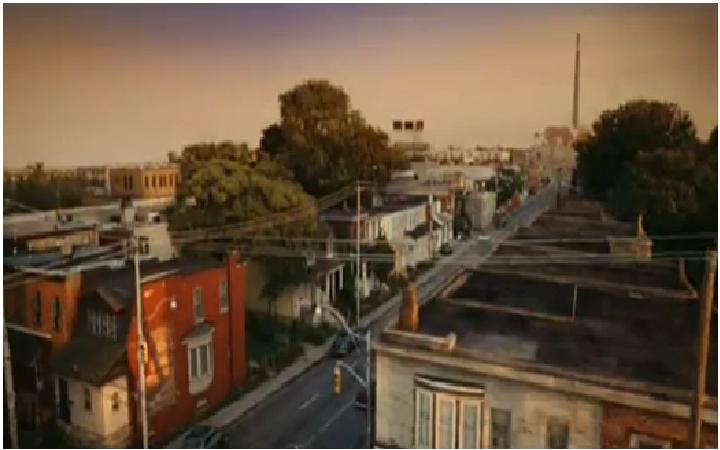
    • Zoom in from VLS, almost a direct birds eye view to establish city setting. We see many houses, and a river/sea.
    • Zoom in on newspaper showing 'Baltimore, MAY 3 1962' place, date and time of day all quickly established.
    • CU of men shining shoes, HA of man opening shutters to shop, LS of women crossing a road. Morning routine for other characters. 
    • More shots of setting.
    • CU of alarm clock- signal for the entrance of our main character- CU of her eyes. 
    • Quick paced editing of her getting out of bed and getting dressed, CU's of  feet, arms, full face shot not until film is introduced (by title shot shown above)
    • Shot of hairspray nozzle facing the camera, spraying a mist of hairspray. 
    • Cross cut from fridge door opening to inside fridge shot- looking out at Tracy. 
    • Frame within a frame, 2.58. 
    Sound

    • Diegetic noises: seagulls, car honks, cats and dogs, bicycle bell, general hustle and bustle of the streets. 
    • Upbeat orchestral musics begins to play, start of 'Good Morning Baltimore' opening song. 
    • Alarm clock goes- signal for the entrance of our main character
    • Song gains volume as title of film appears. 
    • Television plays in conjunction with the song- same lyrics spoken/sang.
    • Comedic screams as women encounter the 'flasher', and comedic thud as 'bum' hits his head on the bar counter 
    • School bell, 4.20.

    Mise-en-scene

    • Bright natural lighting, outdoors, happy content atmosphere.
    • Smiling and bubbly Tracy presents an optimistic outlook on life- especially towards things such as her missing the school bus and the rats. She interacts with everything around her.